Parts / Crusher Eccentric Assemblies
Eccentric Assemblies and Bushings for Gyratory Crushers
Quick answer
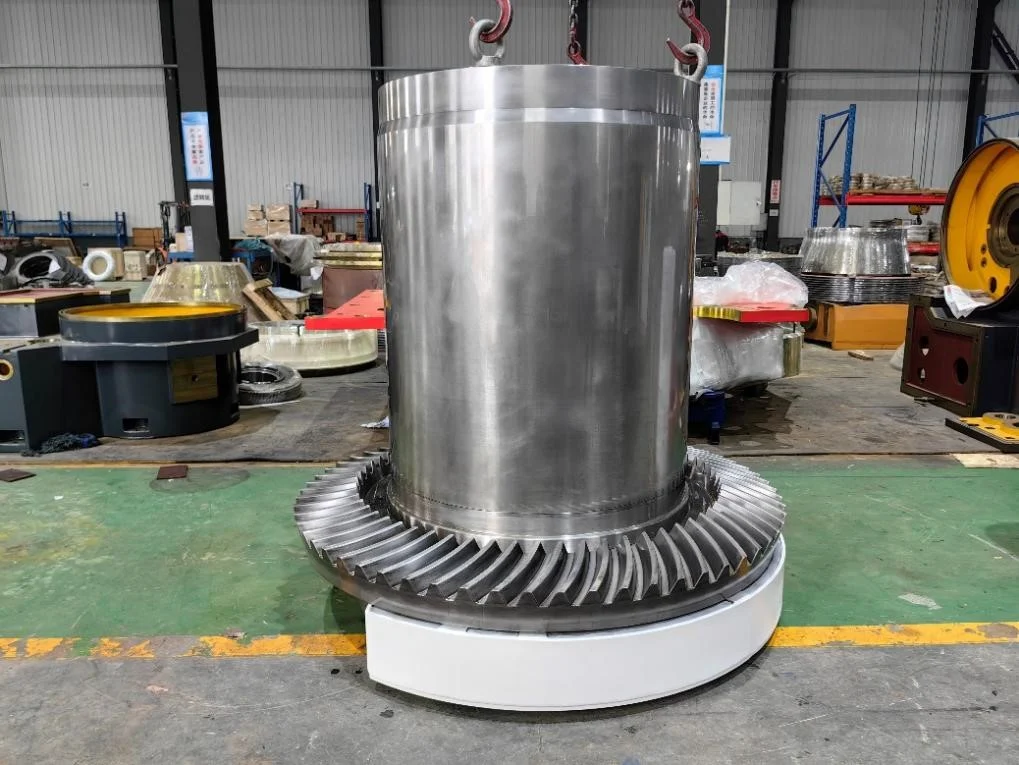
The eccentric assembly is what makes a gyratory crusher gyrate. It is a heavy cast steel body bored off-centre, carrying a bronze bushing on its bore, a spiral bevel gear driven by the countershaft pinion, and a counterweight opposite the offset mass. The lower end of the main shaft sits in that offset bore, so turning the eccentric walks the shaft around a small circular path and opens and closes the gap between mantle and concaves.
What the part does
The eccentric sits in the bottom shell, supported vertically on a step bearing, with a bronze bushing between its bore and the main shaft journal and a further bearing between its outside diameter and the bottom shell bore. The bevel gear bolts to it and meshes with the countershaft pinion. The counterweight exists to cancel the rotating unbalance created by the offset — without it the assembly would try to walk off axis. The bushing is a capacity specification, not just a wear part. The amount of offset sets the throw, and throw drives tonnage: at a given countershaft speed, capacity increases as eccentricity increases. Different throws are obtained by changing the bushing or sleeve. That makes the bore and outside diameter of that bushing a process decision as much as a fit.
How it fails
Bushing wear, scoring and bronze loss — the normal wear-out mode, showing rising oil return temperature, bronze particles and climbing copper in oil analysis, growing clearance, setting drift and knocking. Lubrication failures: rock dust past the seals, degraded or wrong-viscosity oil, or loss of flow, where scoring with localised overheating tends to point to contamination or wrong viscosity and sudden seizure points to starvation, cooling failure, or an assembly that was too tight. Wrong fit at assembly: too tight and thermal growth seizes it, too loose and the crushing load arrives as impact instead of being carried on an oil film. Bevel gear and pinion damage from incorrect mesh or backlash — noise, uneven tooth contact, pitting and spalling, iron in the oil. Cracking of the eccentric casting itself, usually from tramp iron impact or a casting defect. Step bearing wear, showing up as loss of vertical position and setting drift. Fits, clearances and oil temperature limits are model-specific. Take them from the crusher manual or from measurement of the actual housing — published figures vary widely between sources and are not interchangeable between size classes.
How Monmet supplies them
Monmet supplies crusher components including eccentric bushings, spiral bevel gearing, forged main shafts, countershafts, sleeves, bottom shells, mantles, concave segments, thrust bearings and main frames, sourced and managed through its global foundry, forge and machine shop network. Reverse engineering is a standard service where drawings are unavailable — including capturing the geometry of a worn part and deciding what should be restored to nominal versus reproduced as-is, which is a judgement the drawing alone cannot make. Bronze bearing liners and bushings are a long-standing part of the catalogue across mining, cement and metallurgical work. Monmet is ISO 9001:2015 certified by SGS.
What Monmet needs to quote
Crusher size class and serial number — the same nominal model changes across production runs. The worn part itself where possible, plus its mating parts; this is the single most useful thing you can send. Eccentric: overall height, outside diameter, bore, and the eccentricity or throw; gear mounting face, bolt circle and hole detail; oil gallery geometry; keyways and dowels. Bushing: bore, outside diameter, length, wall, oil groove pattern and orientation, and the intended running clearance — plus whether you want the same throw or a different one. Bevel gear: tooth count, module, pressure angle, spiral angle and hand, face width, mounting distance and backlash — and whether the mating pinion is being replaced at the same time, because bevel gears run as matched sets and a new gear against a worn pinion is a common way to lose a replacement early. Counterweight mass and centre of gravity, or the exact geometry. Measured as-worn main shaft journal diameter and bottom shell bore — both drift over decades of rebuilds. Oil grade, flow, pressure and return temperature history, plus oil analysis trend; this usually explains what killed the last one.
Frequently Asked Questions
Related Parts
Start Your Project
Request a Quote
Talk to our specialists and find other ways of forming and shaping metal. There are options aside from casting and forging, such as metal spinning, extrusion and drawn metals.
Get in Touch
Let's discuss your next project.
Send us a drawing, a sample photo or the part description. A Monmet specialist will review it and follow up with a quote.