Parts / Mill Shell Sections
Mill Shell Sections for SAG and Ball Mills
Quick answer
A mill shell is the rotating cylindrical body of a SAG or ball mill — the drum that carries the ore and grinding media and transmits drive torque to the charge. It is a structural component rather than a wear component: it never touches ore directly, but it carries reversing bending, torsion and hundreds of drilled liner bolt holes for decades. Monmet supplies replacement shells and shell sections to your drawing, or reverse-engineered from the mill you already have.
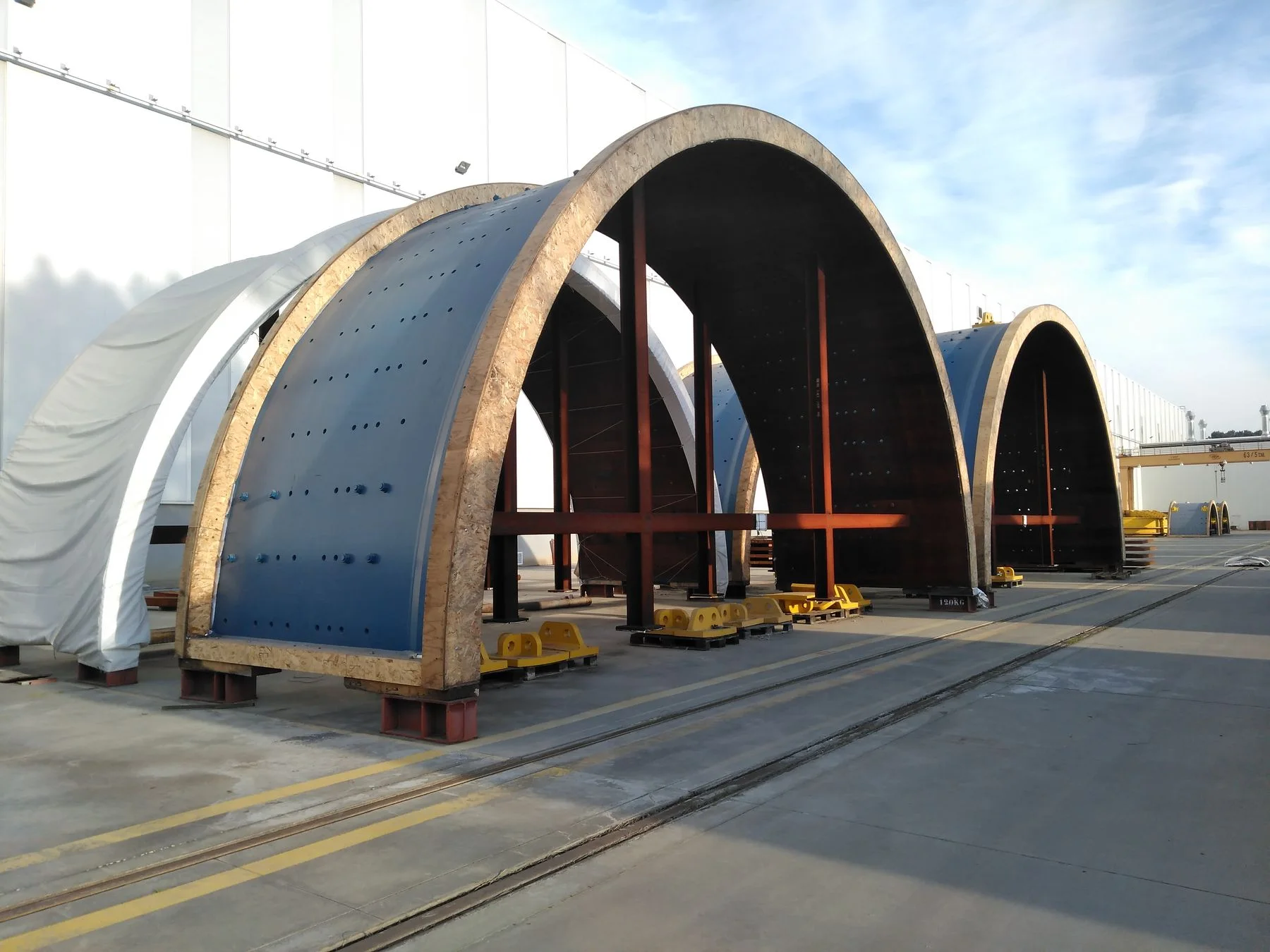
What the part does
The shell is closed at each end by the feed and discharge heads and drilled with a repeating pattern of liner bolt holes, on which the entire lining system hangs. Where a shell is made in sections, the joints are machined flanges with a male and female register — the register carries the shearing load so the bolts carry clamp load only. Sectioning is usually driven by shipping and lifting limits at site rather than by design preference.
How the shell actually fails
In practice, shells are rarely condemned by gross fatigue. They are condemned by the bolt holes and by what leaks through them. Bolt hole elongation, ovalling and peening: holes wear and distort with age, bolts stop holding tension, and liners begin to shift, and repeat bolt breakage in the same holes is the classic symptom. Slurry racing under the liners: where backing rubber or the bolt seal has failed, slurry gets between liner and shell and washes the wall from the inside, it runs undetected for long periods, and wet streaking or rust runs from bolt holes on the outside of the shell is the tell. Fatigue cracking initiating at bolt holes, weld toes and flange transitions. Flange joint problems — bolt relaxation, fretting on the faces, loss of the register fit. Loss of roundness, usually following overload, wash, or repair welding without stress relief. Magnetic particle inspection finds surface cracking, ultrasonic testing finds wash and wall thinning without pulling liners, and 3D laser measurement finds roundness and centreline error.
How Monmet supplies them
Monmet supplies grinding mill shells, heads, trunnions and the associated gears and pinions through its worldwide network of foundries, forge shops and machine shops, and manages the work from engineering through to finished machined components. Reverse engineering is a standard part of the service: where original drawings were lost, never released, or no longer match the mill after decades of rebuilds, the existing part and its mating interfaces can be measured and documented into a manufacturing drawing set. For cement, lime and pulp and paper plants, Monmet also supplies kiln shell sections, with or without mounted riding rings. Monmet is ISO 9001:2015 certified by SGS.
What Monmet needs to quote
The more of this you have, the faster and tighter the quote: mill type (AG, SAG, ball, rod), inside diameter, EGL or flange-to-flange length, speed, installed power, direction of rotation, wet or dry; whether the shell is integral or sectioned, how many sections, and whether longitudinal split flanges are present; flange drawings, including bolt circle, bolt count, hole size, angular indexing datum, and the male/female register dimensions and fit; liner bolt hole pattern — hole diameter, circumferential and axial pitch, number of rows, indexing relative to the flange datum, and the bolt head type the pockets are cut for; plate grade and thickness by section, and any low-temperature toughness requirement; manhole position and frame detail, and the girth gear mounting interface if the gear lands on the shell; welding and inspection requirements, and dimensional and roundness tolerances; road, rail, port and crane limits at site — this decides whether the shell ships whole or split. One thing worth measuring rather than assuming: if you are replacing a single section into an existing mill, the mating flanges should be measured as-built rather than taken from the original drawing. After decades of service, fretting, wear and re-machining, the drawing and the mill are rarely the same thing.
Frequently Asked Questions
Start Your Project
Request a Quote
Talk to our specialists and find other ways of forming and shaping metal. There are options aside from casting and forging, such as metal spinning, extrusion and drawn metals.
Get in Touch
Let's discuss your next project.
Send us a drawing, a sample photo or the part description. A Monmet specialist will review it and follow up with a quote.